

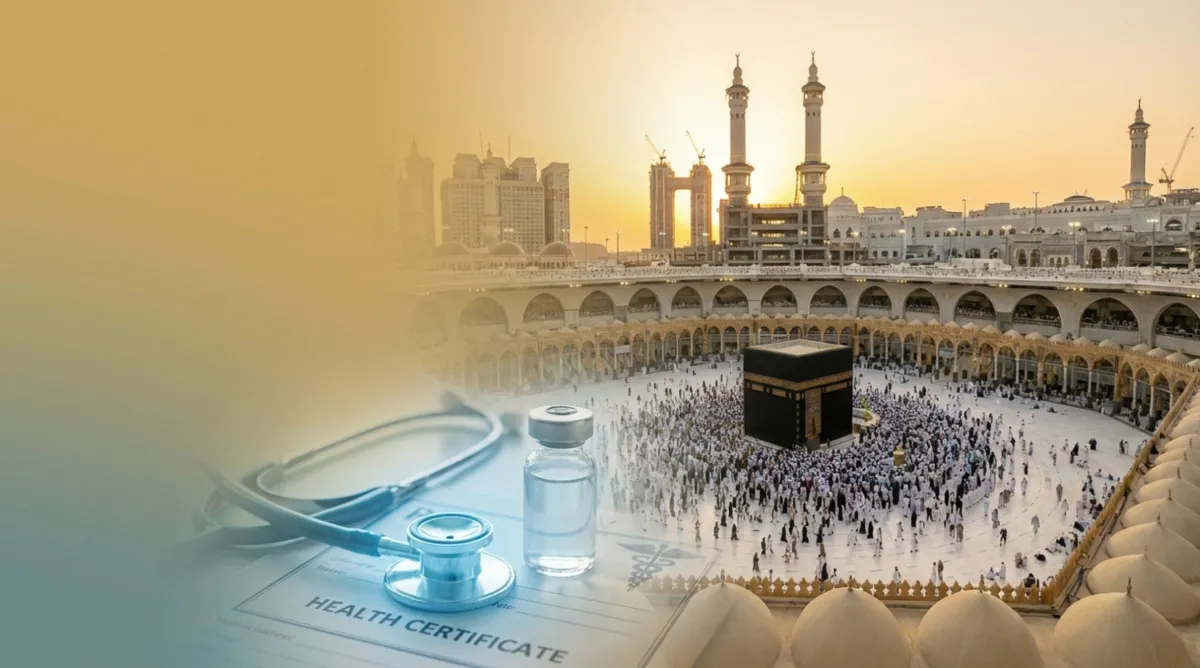
Health Certificates, Vaccines, and What Pilgrims Need Before Travel to Hajj 2026
Planning to perform Hajj in 1447H (May 24–29, 2026)? Before you pack for your journey to Makkah, there is an important step many pilgrims overlook: meeting Saudi Arabia’s mandatory health requirements.
Each year millions of Muslims travel to Makkah and Madinah to perform the sacred rituals of Hajj. This year’s Hajj health regulations require specific vaccinations, medical declarations, and – for the first time many pilgrims are realizing – a signed health certificate from a qualified medical provider confirming you are medically able to safely perform the physically demanding rituals of Hajj.
Here’s everything you need to know and what to do right now to prevent travel delays and allow you to focus fully on the spiritual experience of the pilgrimage.
The Hajj Health Certificate Declaration: Why You Need a Travel Medicine Provider
Many pilgrims are surprised to learn that their Hajj travel provider or visa program requires a medical certificate confirming they are physically fit to perform the pilgrimage.
This isn’t a form you can fill out yourself. You need a licensed healthcare provider who understands the physical demands of Hajj – the walking, the heat exposure, the crowds – to review your medical history and confirm that you can safely perform the pilgrimage.
At TravelBug Health, this is exactly what we do. As Scottsdale’s certified travel medicine specialists, we provide comprehensive pre-Hajj medical evaluations, all required vaccinations, and signed health declarations – all in a single visit.
Schedule your Hajj health evaluation today
Required Vaccinations for Hajj 2026
Meningococcal Meningitis ACWY (Required for ALL Hajj and Umrah Pilgrims)
- Vaccine: Quadrivalent meningococcal conjugate vaccine (MenACWY)
- Timing: Must be administered at least 10 days before arrival and within the previous 5 years.
- Who needs it: Every single Hajj and Umrah pilgrim, including domestic travelers and seasonal workers in Hajj/Umrah areas.
⚠️ Important: The certificate must clearly state “conjugate” for the full 5-year validity. If it doesn’t, Saudi authorities will only accept it for 3 years.
Meningococcal disease can spread rapidly in large gatherings, which is why this vaccine has been mandatory for Hajj pilgrims for many years.
Polio Vaccination (Required for Travelers from Certain Countries)
Pilgrims arriving from or recently visiting countries where poliovirus transmission occurs must provide proof of vaccination.
Depending on the country of origin, requirements may include:
- Inactivated polio vaccine (IPV) administered 4 weeks to 1 year before travel
- Bivalent oral polio vaccine (bOPV) administered before departure
- In some cases, an additional dose given upon arrival
Countries subject to these requirements are periodically updated by Saudi health authorities.
Note: Only the Inactivated polio vaccine (IPV) is available in the US and the US is not currently considered a polio endemic country.
Yellow Fever (Required for Travelers from At-Risk Countries)
- Who needs it: All travelers aged 9+ months arriving from – or transiting through (airport layover >12 hours) – countries at risk of yellow fever transmission
- Timing: Vaccine must be given at least 10 days before arrival
- Validity: Lifetime (both new and existing certificates)
This requirement applies primarily to travelers arriving from parts of sub-Saharan Africa and South America where yellow fever transmission occurs.
COVID-19 (Required for High-Risk Pilgrims)
Required for Hajj and Umrah pilgrims who have any of the following conditions:
- Aged over 65 years
- Chronic cardiovascular, neurological, or respiratory diseases
- Chronic kidney disease
- Hereditary blood disorders (sickle cell anemia, thalassemia)
- Immunodeficiency (congenital or drug-induced)
- Cancer
- Pregnancy
COVID-19 vaccination remains recommended for all pilgrims according to international public health guidance.
Influenza (Strongly Recommended)
- Who: All pilgrims and seasonal workers – especially pregnant women, children under 5, adults over 65, and those with chronic conditions
- Timing: At least 10 days before arrival in Hajj/Umrah areas
- Why: Hajj creates the perfect environment for respiratory illness – millions of people in extremely close quarters
Umrah Travelers
Pilgrims traveling to perform Umrah must also meet the meningococcal vaccination requirement.
Travelers arriving from certain countries experiencing cholera transmission may also be subject to additional public health requirements determined by Saudi authorities.
Additional Recommended Vaccinations
Travel medicine experts also recommend ensuring routine vaccines are up to date before international travel.
- Hepatitis A – spread through contaminated food and water
- Hepatitis B – especially relevant given potential for minor injuries in crowds
- Typhoid – food and waterborne disease risk
- MMR (Measles, Mumps, Rubella) – large gatherings increase measles risk
- Tdap (Tetanus, Diphtheria, Pertussis) – pertussis is especially prevalent and contagious
- Varicella (Chickenpox)
- Polio – ensure adequate primary series plus 1 adult dose
Protecting Your Health During Hajj
Vaccinations are only part of the equation. Saudi health authorities and the WHO strongly encourage these precautions:
Heat Protection
Temperatures in Makkah during Hajj regularly exceed 40°C (104°F) and can reach 50°C (122°F). Heat exhaustion and heat stroke are serious risks.
- Avoid direct sun exposure during peak hours
- Drink fluids frequently – don’t wait until you’re thirsty
- If you take diuretics or other medications that affect hydration, consult your provider before travel
- Carry oral rehydration salts
Respiratory Hygiene
To reduce the risk of respiratory infections:
- Wear masks during rituals and in crowded locations
- Practice frequent handwashing (soap and water for 20 seconds, or 60%+ alcohol hand sanitizer)
- Avoid sharing personal belongings
- Stay away from visibly ill individuals
MERS-CoV Precautions
While no cases have been reported among Hajj pilgrims, Middle East respiratory syndrome coronavirus (MERS-CoV) remains a concern in the region.
- Avoid contact with camels in farms, markets, or barns
- Do not consume raw camel milk, camel urine, or improperly cooked meat
Insect Bite Prevention
While the Aedes aegypti mosquito (which transmits chikungunya, dengue, and Zika) hasn’t been detected in Hajj areas for years, it is present in surrounding cities. Use insect repellent and wear protective clothing.
Medication Restrictions: Don’t Get Caught at Customs
Saudi customs authorities strictly regulate medication imports. Certain prescription drugs – particularly narcotics and psychotropic medications – require advance electronic clearance from the Saudi Food and Drug Authority.
What To Do:
- Keep all medications in their original, labeled containers
- Carry a letter from your prescribing provider listing your medications
- Check with the Saudi FDA if you take any controlled substances
- Apply for electronic clearance well before your departure date
Your Pre-Hajj Health Checklist
- Schedule a pre-Hajj medical evaluation (4–6 weeks before travel is ideal)
- Get your meningococcal conjugate vaccine (required for ALL pilgrims)
- Update any other required vaccinations based on your country of origin
- Obtain your signed Hajj health declaration
- Review your current medications with your provider
- Stock up on OTC essentials: Imodium, oral rehydration salts, sunscreen, masks, hand sanitizer
- Get electronic clearance for any restricted medications
Hajj Travel Clinic in Phoenix and Scottsdale
Pilgrims from Phoenix, Scottsdale, Tempe, Mesa, Chandler, and across Arizona often visit TravelBug Health for pre-Hajj travel consultations.
In one visit, we can:
- Complete your medical fitness evaluation
- Administer all required and recommended vaccinations
- Provide your signed Hajj health declaration
- Review your medications for Saudi customs compliance
- Give you personalized health advice for safe travel
Norman Bizon, PA-C, CTH® is a travel medicine specialist certified by the International Society of Travel Medicine (ISTM) with extensive experience preparing travelers for international journeys and mass gatherings, including Hajj and Umrah.
Call us: (480) 435-2774 Book online: travelbughealth.com/contact Visit us: 8603 E Royal Palm Rd, Ste 120, Scottsdale, AZ 85258
Hajj Mubarak. May your pilgrimage be safe, meaningful, and blessed.
