

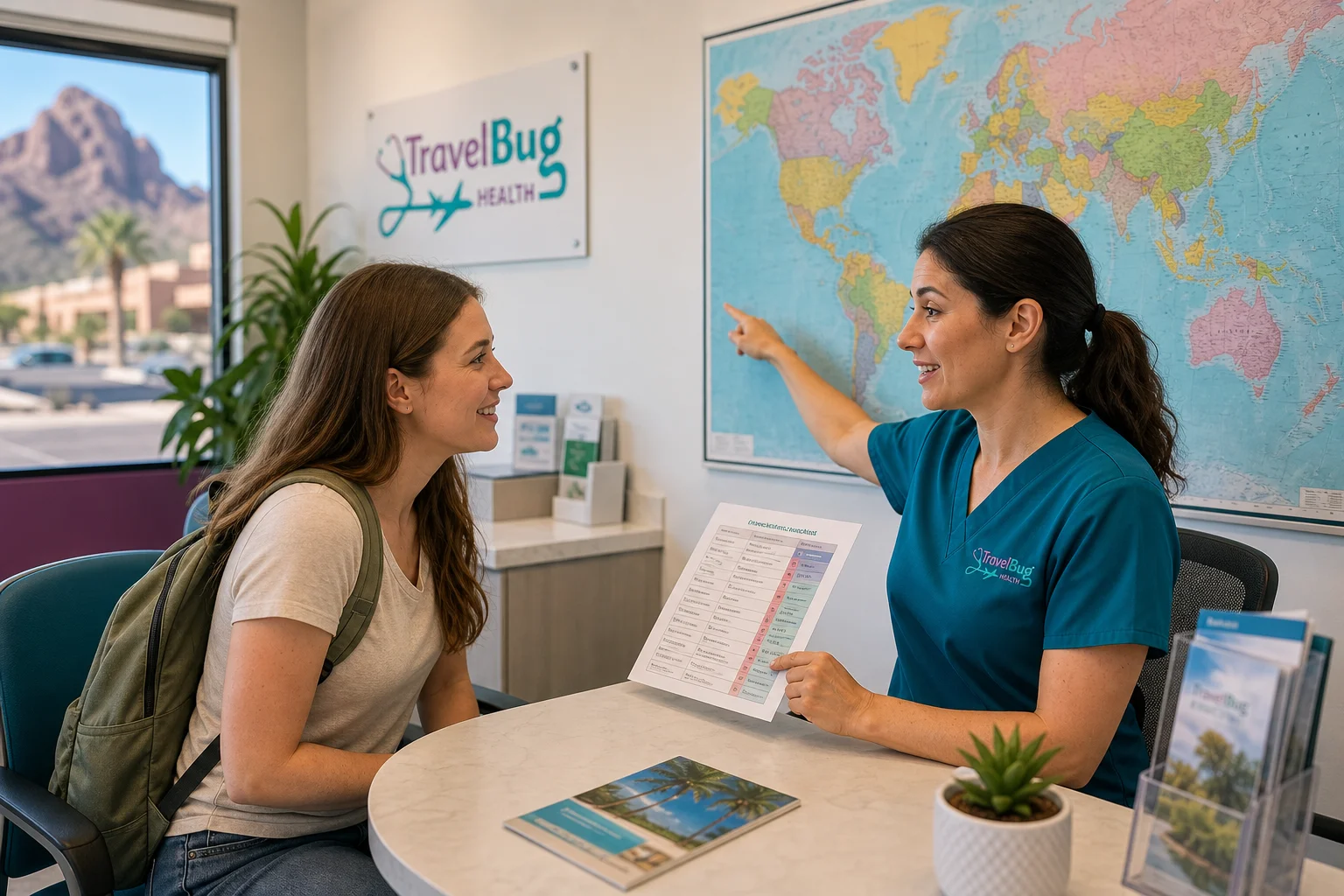
Before a single study-abroad flight departs from Phoenix or Tucson, Arizona students must confirm the travel vaccines every Arizona study-abroad student needs for a healthy 2026 semester. Required shots vary by destination country and include yellow fever, typhoid, hepatitis A, and others that may take weeks to complete. Visit our Travel Clinic for a personalized, current checklist.
By TravelBug Health Team, Travel Health Specialists
Why Study-Abroad Travel Health Planning Starts Months Early
Study-abroad programs rank among the most rewarding academic experiences available to students in the United States, and Arizona schools send thousands of students abroad each year through ASU, the University of Arizona, Northern Arizona University, Grand Canyon University, and affiliated partner institutions. But the health preparation required for an international semester is consistently underestimated, and the window to complete it is shorter than most students expect.
Unlike a brief vacation, a semester in Southeast Asia, sub-Saharan Africa, Latin America, or Europe exposes students to disease environments and public health risks that differ significantly from home. Many partner universities now require verified immunization records before granting campus or dormitory access, and some countries require proof of vaccination at the border itself. Travel health is a specialty for a reason: requirements shift with outbreak data, seasonal patterns, and the specific region within a country where a student will live and study.
The Complete List of Travel Vaccines Every Arizona Study-Abroad Student Needs
Regardless of destination, several vaccines are recommended for nearly all international travelers departing from the United States:
Hepatitis A
Hepatitis A spreads through contaminated food and water and is one of the most frequently reported vaccine-preventable illnesses among international travelers. The two-dose series provides long-term protection, and students who have not completed both doses should begin as soon as a destination is confirmed.
Typhoid
Typhoid fever is common in South Asia, Southeast Asia, Africa, and parts of Latin America, where sanitation infrastructure differs from what students are accustomed to at home. The CDC recommends typhoid vaccination for all travelers to those regions. Both injectable and oral formulations are available, and your travel health provider can advise which fits your departure timeline.
Hepatitis B
Most Arizona students received the hepatitis B series during childhood, but verifying immunity before a semester abroad is worthwhile. If any uncertainty exists, a titer test can confirm whether you have immunity or need re-immunization.
Meningococcal Vaccine
University campuses internationally have frequently documented meningococcal disease outbreaks, particularly in shared dormitory settings. The quadrivalent vaccine (MenACWY) and the MenB vaccine are both worth reviewing with your provider based on your specific destination and living situation.
Routine Immunizations
Before reviewing destination-specific vaccines, confirm your routine immunizations are current. These include MMR (measles, mumps, rubella), varicella, Tdap, and seasonal influenza. Measles outbreaks have occurred in several countries that host large study-abroad programs, and an up-to-date MMR remains one of the most important steps for travel safety before any international trip.
Yellow Fever Vaccine: When Proof of Vaccination Determines Entry
The yellow fever vaccine occupies a unique category in international travel because it is not merely recommended but legally required for entry into more than 40 countries. Under the WHO International Health Regulations (2005), travelers arriving from or transiting through a yellow fever-endemic country must carry a valid International Certificate of Vaccination or Prophylaxis (ICVP), the document widely called the yellow card.
If your study-abroad program is in sub-Saharan Africa or parts of South America, proof of yellow fever vaccination is a hard border requirement. Some countries refuse entry without it, and airlines may check documentation before boarding. Before your trip, check with your travel health provider about the exact entry requirements for your destination country, as medical regulations can shift during active outbreak periods.
The yellow fever vaccine is a live virus vaccine and requires a discussion with a travel health specialist to determine whether the vaccine is safe or appropriate for your situation. It also cannot be given within four weeks of certain other live vaccines such as MMR. This timing constraint is one of the strongest reasons to schedule your pre-travel appointment at least six to eight weeks before departure, a window our yellow fever vaccination timeline breaks down in detail. Only authorized yellow fever vaccination centers can issue a valid ICVP, so confirm your provider holds this certification before you book.

Destination-Specific Vaccines to Discuss Before You Fly
Beyond the core checklist, your destination country may call for additional vaccines worth discussing at your pre-travel appointment:
Japanese Encephalitis
Students heading to rural or agricultural areas of Asia for programs longer than one month should discuss the Japanese encephalitis vaccine. The two-dose series requires at least one week between doses, and full protection can take two to four weeks to develop, so planning well in advance is required.
Rabies Pre-Exposure Prophylaxis
Students working with animals, conducting fieldwork in remote regions, or studying in countries where post-exposure rabies treatment is unreliable should ask about the two-dose rabies pre-exposure prophylaxis series. Being protected with the pre-exposure rabies series can potentially keep you from having to end your program in the event of exposure to rabies. Completing it takes several weeks but is critical for anyone in a high-risk environment.
Cholera
The oral cholera vaccine is recommended for travelers heading to active outbreak areas or students involved in public health fieldwork in regions with limited water sanitation. The cholera vaccine available in the U.S. is a single-dose oral live vaccine and is usually only stocked in a specialty travel clinic.
Malaria Prevention
There is currently no licensed malaria vaccine for most adult travelers heading to endemic regions, but prescription antimalarial medication is a key part of travel safety planning for students going to sub-Saharan Africa, parts of South Asia, and portions of South America. Your travel health provider will tailor the medication recommendation to your specific itinerary and health history. Physical prevention such as repellent and protective clothing matters just as much, and our insect bite protection strategies post covers that layer in more depth.
How to Time Your Pre-Travel Appointment for Full Protection
Most Arizona students underestimate the time required to complete a full pre-travel vaccine schedule. The CDC recommends scheduling a pre-travel consultation at least four to six weeks before departure, but students who need yellow fever vaccine, Japanese encephalitis, rabies pre-exposure, or a multi-dose hepatitis series should plan for six to eight weeks or more.
Many vaccines require two or three doses spaced weeks apart. Waiting until two weeks before your flight means completing a full series before boarding is unlikely. The yellow fever vaccine alone requires 10 days after administration before it is considered effective under international entry standards. Phyllis Kozarsky, a travel medicine specialist, former CDC Yellow Book contributor, and author in the Journal of Travel Medicine, has consistently emphasized that late-scheduled pre-travel consultations are among the most common reasons student travelers arrive abroad without complete vaccine coverage.
Knowing which travel vaccines every Arizona study-abroad student needs also means knowing when to get them. Schedule an Appointment with TravelBug Health as soon as your program acceptance arrives. You do not need a confirmed flight to begin your vaccination planning.
Frequently Asked Questions
Does my Arizona university health center cover travel vaccines?
Most university health centers in the United States carry routine vaccines but do not stock specialty travel vaccines such as yellow fever, Japanese encephalitis, or rabies. They are also typically not authorized to issue the International Certificate of Vaccination required for countries with yellow fever risk. Insurance coverage for travel vaccines varies by plan, and some insurers treat certain travel vaccines as an elective expense rather than a covered preventive service, so it is worth calling your insurer directly to confirm what is covered before your appointment. A dedicated travel health clinic is the correct starting point for complete study-abroad vaccine preparation.
How long does a yellow fever vaccination remain valid?
As of the WHO's 2016 revised guidelines, a single dose of the yellow fever vaccine is considered valid for life for most travelers. Exceptions include vaccination before nine months of age, vaccination during pregnancy, or vaccination while immunocompromised. Your travel health provider can review your specific record and confirm whether your dose qualifies for lifelong status.
Can I receive all my travel vaccines in one appointment?
In many cases, yes. Multiple vaccines can be administered at a single visit. Some combinations require spacing, particularly live vaccines like yellow fever and MMR, which must be at least four weeks apart if not given on the same day. Other vaccines may need multiple doses to complete a series. Your provider will build a schedule that fits your departure timeline and ensures each vaccine reaches full effectiveness before you board.
What if I already received some vaccines as a child?
Many childhood vaccines remain effective into adulthood, but titer tests can measure current immunity levels for hepatitis A, hepatitis B, and MMR when there is any uncertainty. Bring whatever vaccination records you have, including a childhood immunization card, so your travel health provider can identify gaps and avoid unnecessary repeat doses.
Does international health insurance take the place of travel vaccines?
No. International health insurance covers medical costs if you get sick or injured abroad. Travel vaccines prevent illness before you leave. Both are essential parts of a complete travel safety plan, and most study-abroad programs require proof of international health coverage separately from vaccination documentation.
Plan Your Study-Abroad Semester With Full Confidence at TravelBug Health
The travel vaccines every Arizona study-abroad student needs in 2026 depend on your destination, activities, and departure timeline, and our specialists are ready to map it all out for you. Contact Us to schedule your pre-travel consultation and ensure you arrive at your program fully protected, properly documented, and ready to focus on what matters.
