


What Happens at Your Scottsdale Travel Clinic Visit (Step by Step)
At your Scottsdale travel clinic visit, a specialist reviews your itinerary, assesses destination health risks, administers required vaccines, and sends you home with complete travel health documentation. Our Travel Clinic follows a clear, step-by-step process so you arrive knowing what to expect and leave fully prepared.
By TravelBug Health Team, Travel Health Specialists
Step 1: Pre-Visit Intake and Your Travel Itinerary
Before you sit down with a specialist, the visit begins with a structured intake form. As part of your intake, we will ask you to provide your full itinerary, including every destination country, planned activities (safari, trekking, river travel), and trip duration. Layovers in certain regions can trigger additional vaccine requirements, so every leg of the route matters.
This step is foundational because travel health is destination and activity specific. A month in South America carries different exposure risks than two weeks across Southeast Asia. A rural trekking route requires a different preparation plan than a business stay in a major city. The intake form lets your specialist prepare before you sit down, so your consultation focuses on decisions rather than data collection.
Bring your vaccination records, your International Certificate of Vaccination or Prophylaxis (ICVP) if you have one, a list of current medications, and any diagnosed medical conditions. Complete intake records allow your specialist to deliver precise health advice from the first minute of your appointment.
Step 2: One-on-One Consultation with a Travel Health Specialist
Once intake is reviewed, you sit down with a certified travel health specialist for a focused, private consultation. This is the stage of your Scottsdale travel clinic visit where personalized health advice shapes every recommendation that follows.
Your specialist reviews your itinerary region by region, identifying the specific health risks tied to each destination. Factors like age, existing medical conditions, immunization history, risk tolerance, and travel style all shape the recommendations. A backpacker in shared accommodations faces different exposure risks than a traveler staying in a managed resort.
Many travelers arrive unsure whether they need certain vaccines, whether old vaccines still provide coverage, or whether a chronic medication interacts with antimalarial prescriptions. Your specialist provides honest, evidence-based answers grounded in current outbreak data and published health guidance.
For travelers heading to South America, Central Africa, or other regions with endemic disease zones, the consultation includes detailed discussion of yellow fever requirements, malaria chemoprophylaxis, and insect-borne illness prevention.
Step 3: Destination Risk Assessment and Required Vaccines
After the consultation, your specialist builds a destination-specific risk profile that identifies which vaccines are legally required for entry and which are strongly recommended based on your activities and regional disease patterns.
Some vaccines are legal entry requirements. Yellow fever vaccination is the clearest example: multiple countries in West Africa and parts of South America will deny entry or require proof of yellow fever vaccine at the border. Your specialist cross-references current entry requirements from the Centers for Disease Control and Prevention and the World Health Organization.
Beyond required vaccines, the risk profile covers recommended vaccines matched to disease prevalence: typhoid, hepatitis A, hepatitis B, meningococcal, and Japanese encephalitis for specific regions. For travelers heading to rural Asia, Japanese encephalitis is a serious consideration. The World Health Organization classifies Japanese encephalitis as the leading cause of viral encephalitis in Asia, with the highest risk concentrated in rural agricultural areas, per WHO guidance updated through 2015.
Some vaccines require a series of doses spaced weeks apart. Your specialist will map out a timing schedule so every dose is completed before your departure date, giving your immune system the full window needed to build protection.
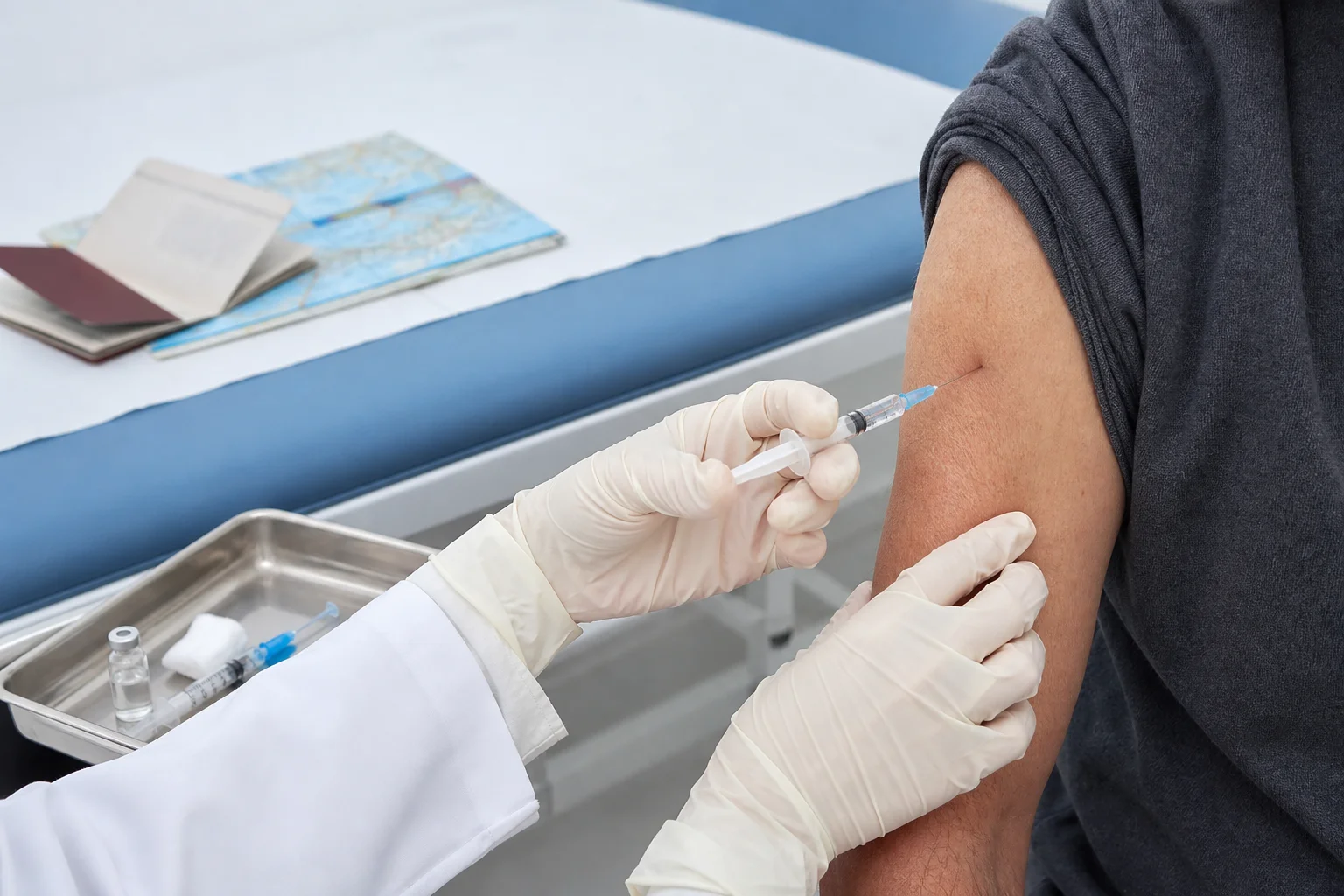
Step 4: Vaccine Administration at Your Scottsdale Travel Clinic Visit
Once the risk profile is confirmed, vaccine administration happens during the same appointment whenever possible. Travel clinics are designed to consolidate everything: travel vaccinations, documentation, and prescriptions handled in a single visit rather than across multiple providers.
The yellow fever vaccine is among the most frequently administered at travel clinics serving international travelers. Yellow fever vaccination is not only a health safeguard but also a legal entry requirement for many destinations, and our yellow fever vaccination timeline explains exactly how far in advance you need the jab for your ICVP certification to be valid at border control. Countries across Central Africa, West Africa, and parts of South America require proof of yellow fever vaccine before a traveler crosses the border.
The yellow fever vaccine is a live attenuated vaccine delivered as a single subcutaneous injection. The World Health Organization updated its guidance in 2016 to recognize that a single dose confers lifelong immunity for most healthy adults. Your vaccination is recorded in your official ICVP, which must be submitted for inspection at border control in requiring countries.
Not every traveler can receive the yellow fever vaccine. Contraindications include age under nine months, severe egg allergies, and immunocompromising conditions. Your specialist will screen for these and discuss waiver documentation options where the vaccine is contraindicated.
Step 5: Prescriptions, Insect Protection, and Preventive Planning
Vaccines address many but not all travel health risks. Conditions without available vaccines may require prescription medications and behavioral precautions, and this planning happens during the same visit.
Malaria prevention is the most common prescription need. Depending on destination resistance patterns, your specialist may prescribe atovaquone-proguanil, doxycycline, or mefloquine, each with different dosing schedules and side effect profiles, and our malaria prevention breakdown covers how those options compare. The right choice depends on your itinerary, destination resistance data, and personal medical history.
Insect bite protection is equally critical for destinations where dengue fever, Zika virus, chikungunya, and leishmaniasis are present. These diseases are transmitted by insect bites and no vaccine currently prevents most of them. Your specialist consultant will recommend insect repellents with DEET concentrations appropriate for the region, permethrin-treated clothing, bed net protocols, and guidance on peak biting hours by destination.
For high-altitude itineraries, acetazolamide may be prescribed to prevent altitude sickness. Traveler's diarrhea antibiotics, oral rehydration guidance, and food and water safety education are standard for most international trips. Cruise passengers and other travelers prone to motion sickness can also discuss prevention options with their specialist, who will recommend a plan suited to their itinerary and medical history. You leave the appointment with peace of mind knowing every realistic health risk for your destinations has been addressed.
Step 6: Documentation, Records, and Preparing for Care Abroad
Before leaving the travel clinic, you receive complete documentation to protect yourself at every border and in every medical setting abroad.
Your records include your completed ICVP certifying yellow fever vaccination and any other vaccines requiring official proof. Your specialist also provides written medication instructions and dosing schedules for any medications you receive, and a summary of relevant medical conditions useful for international medical providers if care is needed during your trip.
Travelers carrying injectables or controlled medications may also receive a provider letter explaining medical necessity, which helps avoid complications at customs checkpoints. For a complete record of your Vaccinations, keep both a physical copy in your carry-on and a digital backup on your phone. If your ICVP is lost abroad, you may need to repeat yellow fever vaccination before re-entering certain countries, so the digital backup provides real protection.
Many travel clinics also send travelers home with destination-specific health advisories, emergency contact protocols, and guidance on accessing quality medical care in each country on the itinerary. The goal is that every piece of information needed to stay safe and seek care abroad is in your hands before you board.
Frequently Asked Questions
How far in advance should I schedule a travel clinic appointment?
Most travel health specialists recommend booking your Scottsdale travel clinic visit four to six weeks before your departure date. Some vaccines require multiple doses spaced weeks apart. The yellow fever vaccine must be administered at least ten days before entry into any requiring country for the ICVP certification to be valid at border control. For multi-region itineraries, eight weeks provides a safer buffer.
Is the yellow fever vaccine required for all international travel?
No, but yellow fever vaccination is mandatory for entry into many countries across sub-Saharan Africa and parts of South America. Some countries also require proof of yellow fever vaccine if you are arriving from a country with endemic yellow fever, even if your final destination does not have its own requirement. Your specialist checks current requirements for every leg of your itinerary, not just the primary destination.
What should I bring to my travel clinic appointment?
Bring your passport, your complete travel itinerary with dates and activities, any existing vaccination records or yellow card, and a list of current medications and dosages, and your health insurance information. Complete records allow the specialist to deliver precise health advice matched to your medical history rather than generic recommendations.
Do travel clinics only provide vaccines?
No. Travel clinics provide a full range of services: destination risk assessment, vaccine administration, prescription medications for malaria and altitude sickness, insect protection guidance, food and water safety counseling, and travel documentation. Some travel clinics also offer post-travel consultations for patients who return with symptoms after a trip abroad.
Can someone with a compromised immune system receive the yellow fever vaccine?
The yellow fever vaccine is a live virus vaccine and is contraindicated for travelers with significant immunosuppression, thymus disorders, or those under nine months of age. If you cannot receive the vaccine, your specialist can prepare medical contraindication documentation that many countries accept in place of the ICVP certificate. Discuss your specific needs with a specialist before booking international travel to regions where yellow fever vaccination is required.
Start Your International Trip With Confidence at TravelBug Health
Every step of your Scottsdale travel clinic visit is designed to replace uncertainty with preparation. From intake review through vaccine administration, prescription planning, and final documentation, the visit puts expert travel health guidance behind every decision you make before departure. Schedule an Appointment and arrive at your destination ready, protected, and confident.
