


Japanese encephalitis explained: the Japanese encephalitis virus is a mosquito-borne flavivirus that triggers dangerous brain inflammation, and is endemic across Asia and the Western Pacific. Most travelers carry low overall risk, but anyone heading into rural areas or planning an extended stay needs to know whether the Japanese encephalitis vaccine belongs in their pre-trip plan. Your Travel Clinic can map your exposure risk.
By TravelBug Health Team, Travel Health Specialists
Japanese Encephalitis Explained: How the Virus Harms the Brain
The Japanese encephalitis virus (JEV) belongs to the Flaviviridae family, placing it in the same genus as West Nile virus, dengue, and Zika. When JEV crosses from the bloodstream into the central nervous system, it triggers a cascade of inflammation in the brain – called encephalitis – that can destroy neurons and compromise the blood-brain barrier. In severe cases, the virus infects the cerebrospinal fluid, a marker clinicians rely on to confirm the diagnosis.
A landmark review by Erlanger et al. published in Emerging Infectious Diseases (2009) estimates approximately 67,900 JE cases occur globally each year, with mortality (death rate) reaching up to 30% among those who develop full encephalitis. Of survivors, roughly one-third carry permanent neurological or psychiatric disability. These figures explain why pre-travel prevention is so important: once JEV establishes itself in the brain, supportive care is the only option because no approved antiviral treatment exists.
The virus circulates through a natural cycle involving Culex mosquitoes (primarily Culex tritaeniorhynchus) and vertebrate amplifying hosts, particularly pigs and wading birds. Humans are dead-end hosts: we do not amplify the virus, and person-to-person transmission does not occur.
Where Risk Is Highest: Asia, the Western Pacific, and Rural Settings
JEV circulates across a sweeping geographic band from India and Nepal in the west through Southeast Asia, north into China, Korea, and Japan, and out into the western Pacific islands including Papua New Guinea and northern Australia. The WHO and CDC jointly designate the Asia Western Pacific region as the primary endemic zone.
Risk within that zone is not evenly distributed. Agricultural landscapes, especially rice paddies near pig farms, create ideal breeding conditions for Culex mosquitoes. Travelers spending time in rural areas, particularly during the warmer, wetter transmission season (May through October in temperate zones, year-round in tropical regions), face considerably higher exposure than those on brief urban itineraries.
Classic tourist destinations can harbor pockets of risk as well. A farm-stay in Japan's countryside, a rural guesthouse in Thailand's Chiang Mai province, or an overland motorcycle route through Vietnam's northern highlands can all put a traveler in Culex mosquito territory, especially around dusk, which is the peak biting window.
Recognizing JE Symptoms: From First Fever to Severe Encephalitis
Erlanger et al. (2009) estimate that fewer than 1 in 250 JEV infections ever produce noticeable symptoms. The vast majority resolve without the traveler knowing they were infected. When symptoms do emerge, the incubation period of 5 to 15 days is followed by progression through distinct phases.
During the early phase (roughly days 1 to 4), sudden high fever, headache, vomiting, and malaise appear and can closely resemble influenza or dengue. A clinician cannot differentiate JE from other mosquito-borne infections on symptoms alone at this stage.
The acute encephalitic phase (roughly days 4 to 14) brings altered consciousness, focal neurological deficits, seizures, and a Parkinsonian rigidity characteristic of advanced JE. At this point, cerebrospinal fluid analysis reveals elevated white cell counts, elevated protein, and, most conclusively, JEV-specific IgM antibodies in cerebrospinal fluid.
No approved antiviral treatment exists for JE. Clinicians manage fever, seizures, and elevated intracranial pressure with supportive care. This clinical reality makes the Japanese encephalitis vaccine the only reliable protection: once the disease takes hold, medical options are limited.
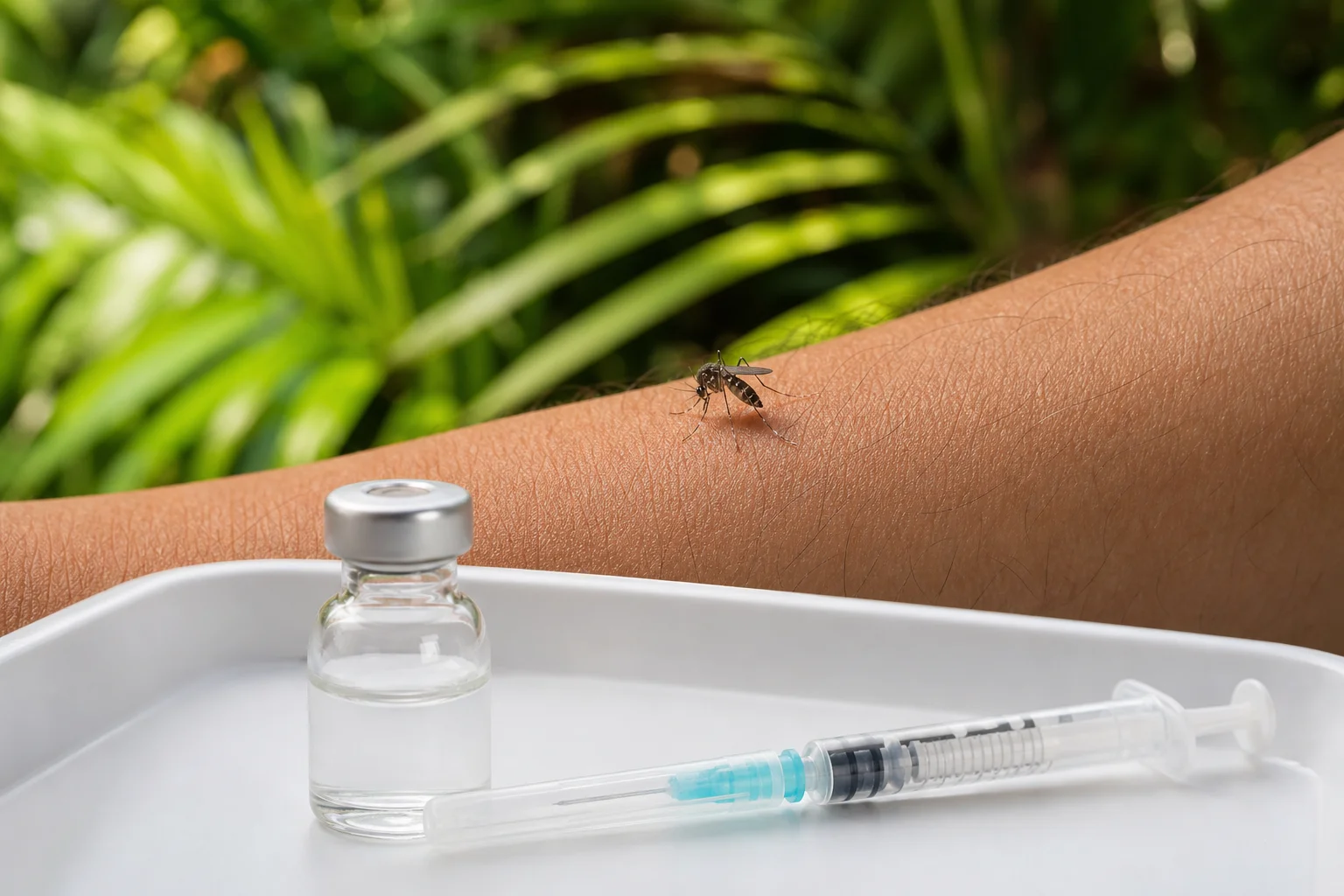
Who Needs the Japanese Encephalitis Vaccine Before Traveling
The risk of japanese encephalitis to the individual traveler comes down to four key factors: destination, itinerary type, duration of travel, and season. The CDC Advisory Committee on Immunization Practices (ACIP) recommends the Japanese encephalitis vaccine for travelers who meet one or more of the following criteria:
- Duration: Any trip lasting one month or longer in an endemic area, regardless of where you sleep
- Rural exposure: Shorter visits that include stays in rural areas near rice fields or pig farms during active transmission season
- Repeat travel: Frequent travelers to the Asia Western Pacific region who anticipate ongoing exposure over multiple trips
- Occupational risk: Laboratory workers handling live JEV, or field researchers working long-term in endemic settings
Short urban-only visits to cities such as Tokyo, Singapore, or Bangkok carry very low risk, and vaccination is generally not indicated for those itineraries. However, even a single night in a rural guesthouse can shift the risk calculus, which is why a personalized evaluation with a specialist matters.
Study-abroad students heading to Asian universities, volunteers on agricultural projects, and adventure travelers planning extended overland routes are strong candidates. Arizona students in particular can start with our study-abroad vaccine checklist to see the full pre-departure list.
If this is your first travel health appointment, expect your specialist to review your itinerary, walk through your health history, and translate both into a personalized vaccine plan, JE included if your trip warrants it. That conversation, not a stack of paperwork, is what actually resolves any uncertainty before you arrive.
Mosquito bites are the only transmission route for JEV, so pairing vaccination with strong repellent habits is worth the effort. DEET, picaridin, and permethrin-treated clothing all reduce mosquito bites across insect-borne diseases, and our insect repellent guide breaks down which option fits your trip.
JE Vaccine Dosing, Timing, and What to Expect
The only Japanese encephalitis vaccine licensed in the United States is IXIARO (Valneva), an inactivated Vero cell-derived vaccine. The primary series for adults and children over two months of age consists of two doses given 28 days apart. For adults ages 17 to 65 who need a compressed timeline, an accelerated schedule (day 0 and day 7) is approved.
Your specialist will align the JE schedule with your departure date and your broader Vaccinations plan. Completing the second dose at least one week before travel allows time for a full immune response to develop. Booster doses may be recommended for travelers who received their primary series more than one year before anticipated re-exposure.
Children receive the same two-dose schedule at a smaller injection volume per dose. Common side effects across age groups include injection-site soreness, redness, or swelling. Mild systemic reactions such as headache and fatigue occur in a smaller proportion of recipients and are generally short-lived.
Because the JE vaccine may be administered alongside other travel vaccines on the same clinic visit, your specialist can bundle it with other pre-departure priorities so you leave with one coordinated schedule instead of several separate appointments.
Frequently Asked Questions
Does Japanese encephalitis mainly affect rural travelers?
Primarily, yes. Most transmission occurs in agricultural zones near rice paddies and pig farms, which generate the highest Culex mosquito densities. Brief stays in major Asian cities carry very low risk. Your travel health specialist will review your overnight accommodations and planned outdoor activities to determine whether your specific itinerary justifies the Japanese encephalitis vaccine.
Can I catch Japanese encephalitis from another person?
No. JEV transmits only through the bite of an infected Culex mosquito. It does not spread through respiratory droplets, direct contact, or body fluids. The virus amplifies in pigs and wading birds; infected humans do not pass JEV onward, so no quarantine or isolation is required.
How do doctors diagnose Japanese encephalitis?
Clinicians look for rapid-onset fever, headache, and neurological changes in a traveler returning from an endemic area. Confirmation comes from detecting JEV-specific IgM antibodies in serum or cerebrospinal fluid. Cerebrospinal fluid analysis also helps rule out bacterial meningitis and other causes of acute encephalitis.
Is the Japanese encephalitis vaccine available for children?
Yes. IXIARO is approved for infants as young as two months. Dosing volume differs from the adult formulation, but the two-dose schedule remains the same. Children traveling to rural endemic areas for extended periods are strong candidates, and your specialist can confirm the correct dose for your child's weight and age.
How is the Japanese encephalitis virus different from West Nile virus?
Both belong to the flavivirus genus and share structural similarities, but they are distinct pathogens circulating in different geographic regions. Prior infection with West Nile virus does not confer cross-protection against Japanese encephalitis virus. A traveler who contracted West Nile infection in the US remains fully susceptible to JEV abroad and should not skip vaccination based on past flavivirus exposure.
Protect Your Asia Trip with a JE Vaccination Consultation in Scottsdale
If your itinerary includes rural destinations, a long-term stay, or any part of the Asia Western Pacific corridor where Japanese encephalitis virus circulates, pre-travel vaccination is the most reliable protection available. Our travel health specialists review your full itinerary and health history to determine exactly which vaccines belong in your plan and when to get them. Schedule an Appointment at our Scottsdale clinic and travel knowing your JE risk is covered.
